The Property Institute (TPI), whose members manage around 2 million homes across the UK, has published research revealing a widening two-tier divide in cladding remediation, with Government-funded schemes completing at more than double the rate of buildings covered by pledged developers. TPI is now calling for the Remediation Bill to include stronger compulsion measures to force developers signed up to the Responsible Actor’s Scheme to act.
At the current rate of progress, TPI estimates it could take around ten years for all developer-pledged buildings to have started remediation works on site.
In 2022, 53 housebuilders signed Government‑led pledges accepting responsibility for fixing life‑critical defects identified in 2,604 buildings they developed. Four years later, many of those schemes remain stuck in assessment or scoping, with little sign of acceleration.
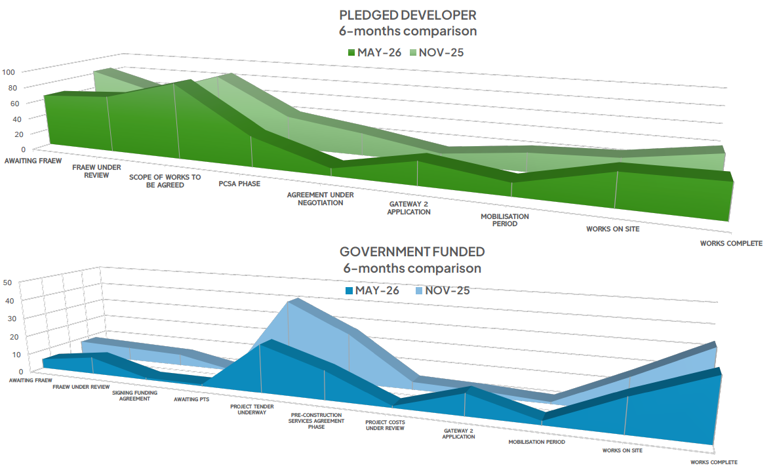
Across 511 buildings with identified cladding remediation needs, collated by TPI from its members, which includes buildings covered by both Government funded schemes and pledged developer, just 24% are in active delivery, with 13.5% complete and 11% currently on site. Around half (48%) of buildings remain stalled in early stages, up from 32% last year.
The findings come following the King’s Speech that confirmed that a Remediation Bill will be brought forward in the next Parliamentary session. As a result of the findings, TPI is calling on the Government to use the legislation to introduce a backstop - a legal enforcement mechanism that automatically kicks in if a developer fails to meet a remediation deadline - that currently will apply only to landlords and not developers.
The Bill will be introduced to close long‑standing gaps in the post‑Grenfell regime and to speed up work across thousands of unsafe buildings. Government estimates suggest between 5,900 and 7,400 residential blocks over 11 metres contain serious defects, with many still awaiting full assessment. The TPI is therefore calling for the scope of the Bill to also cover internal safety defects as well as external cladding.
More promisingly, government-funded schemes recorded by TPI (117 projects) are making considerably faster progress:
• 40% of Government-funded projects are on site or in completion stages, compared to just 19% of developer-pledged projects.
• 26% of Government-funded remediation projects are now complete, up from 13% the previous year.
• Only 14% of Government-funded projects remain at early stages, down sharply from 41% last year, signalling momentum.
Developer-pledged schemes (394 projects assessed) tell a very different story:
• 58% of developer-pledged projects remain at early stages (application or scoping), a proportion that has barely shifted across three data sets over the past 12 months.
• Only 10% of developer-pledged buildings are complete, compared to 26% of Government-funded projects.
• Just 10% of developer-pledged projects have commenced on site, up from 6% last year but still far behind Government-funded counterparts.
Andrew Bulmer, Chief Executive Officer, at TPI said:
“This data is genuinely alarming. Thousands of people across the country are living in unsafe buildings, often unable to sell their homes, having faced nearly a decade of uncertainty since the Grenfell tragedy.
“The fact that the current remediation progress is so slow, with no end in sight, is a national scandal. The goal for the government and everyone involved in the housing sector should be to make these homes safe as soon as possible.
“The government’s Remediation Bill is an opportunity to give developers a legally binding backstop that reassures residents that every step legally possible is being taken to make their homes safe. Pledged developers need a hard deadline to ensure there are no more unnecessary delays.”
“While we wait for the substance of the Remediation Bill, we hope this data serves as a wake-up call for the urgent need for an effective backstop that compels developers to honour their pledges.
“The current backstop in the Bill for missed remediation deadlines applies to landlords, but not to the developers who, more than three years ago, committed to fixing their buildings. A pledge without a deadline is simply not enough, and our data shows it has not been working.
“We need to urgently accelerate the pace of progress so that we can finally close this awful chapter and ensure residents are genuinely safe and protected from further costs associated with living in an unsafe building.”